



A varnish mask that follows a logo edge can make a small press shift visible. Learn how to set a measurable tolerance, prepare the mask, and inspect the first finished cartons.
Gloss shows drift. When clear varnish follows the exact edge of a printed logo on matte laminate, even a small shift can leave a shiny lip on one side and a strip of bare ink on the other, although both layers lined up perfectly in the supplied artwork. Would you catch that in a PDF?
Spot UV registration tolerance is the maximum permitted offset between the cured varnish and its intended position relative to the print. To avoid visible misalignment, agree on that limit with the finisher before sizing the mask, then verify it on a sample made with the production stock and finish.
EXCARD’s published spot UV artwork specification lists ±0.25 mm for standard packaging and ±1.5 mm for short-run packaging, both for its screen-applied spot UV. That is a sixfold difference inside one supplier’s guide. I treat a tolerance quoted before the finisher has reviewed the stock, laminate, and mask as provisional. Get the limit for your job in writing before signing off.
Ask how the finisher measures the number. A limit of ±0.50 mm on each axis permits a diagonal shift of about 0.71 mm when both axes reach their limits together. Mark the print feature and the points where you’ll measure from it. On printed folding cartons with spot coating, also specify clearance from the actual cut or crease when the varnish sits near a panel edge.
Build the mask as solid vector shapes on the approved dieline. Keep the same scale, orientation, trim dimensions, and page origin as the CMYK artwork. Follow the printer’s delivery convention, such as a named SPOT UV separation or a separate mask file in 100% K. Overlay the exported files at full size and check the edges again after any artwork revision. Bring both files to the packaging artwork and prepress review so the same revision goes to proof and production.
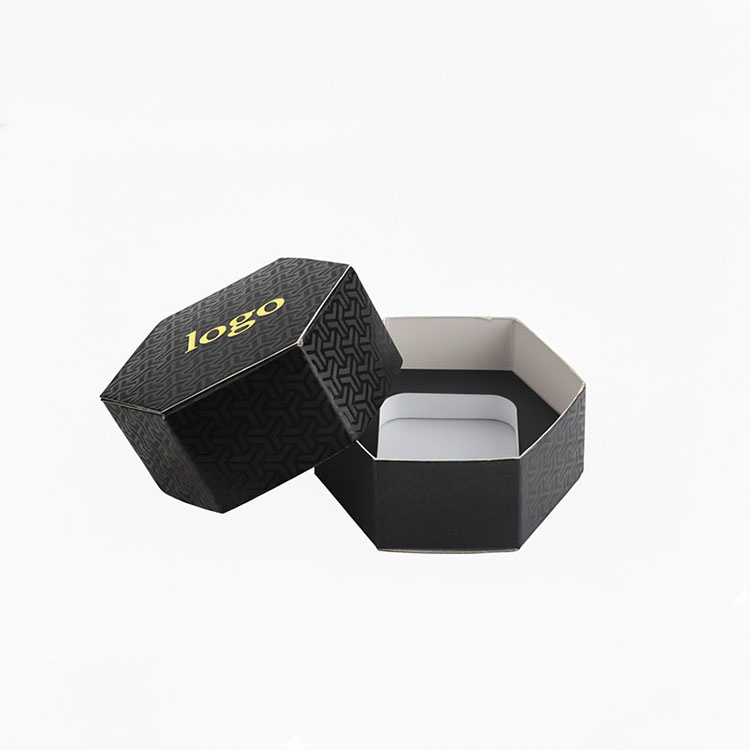
If the gloss must stay inside a printed mark, size the inset around the maximum movement toward each edge. In a simple straight-edge example, a 0.30 mm inset still leaves 0.20 mm of overshoot if the coating shifts 0.50 mm toward that edge. Ask the finisher about coating spread and minimum line width before reducing the mask. If the remaining shapes are too thin to coat cleanly, use gloss on a broader feature or place it as an independent pattern on a solid field. The matte-black VIP card box with gloss detailing shows how tonal gloss can sit alongside a contrasting printed logo.
In a packaging varnish pilot documented by Bern University of Applied Sciences, sensors measured each sheet’s position and the system adjusted the varnish image before jetting it. Steinemann Technology scaled the process to 108 × 78 cm sheets and put pilot equipment into operation at customer sites. A 2020 IPIA report on Route 1 Print documents the MGI JETvarnish 3D Evo 75’s real-time scanner registration without crop marks. Ask your finisher what the machine reads to establish register and which marks, if any, it needs on your artwork.
| What you see | What to check first | How to narrow it down |
|---|---|---|
| The same offset repeats across the sheet | Mask origin or initial register setting | Overlay the approved exports, then compare corresponding ink and gloss edges on a coated sheet. |
| The center aligns but the outer positions drift | Scale, rotation, or sheet distortion | Compare measurements at opposite corners and across the sheet. |
| The offset changes from sheet to sheet | Sheet feed or registration correction | Measure the same feature on several sheets, including after a restart. |
| Ink and gloss align, but both sit too close to a crease | Print-to-die registration or panel clearance | Measure from the print to the actual score and inspect the erected carton. |
The U.S. Government Publishing Office’s 2025 bid record for Sylvanus Thayer: A Biography lists a $106,250 winning bid for the full run of 6,004 books. The dust-jacket specification calls for spot gloss UV to highlight the signature art on the front panel and specifies 65 lb dull coated cover stock. I’d name the varnished feature and stock just as precisely on a carton order, then add the permitted offset and how to check it.
Request a finished packaging approval sample on the actual board or wrap, with the agreed laminate and coating process. Tilt it under low-angle light to find the varnish edge. Use a measuring loupe or calibrated image to check the marked points. For an inset mask, compare the actual gap with the intended gap. Record the largest deviation in each measured direction and where it occurred. Agree on how often to check the run and what happens if a reading exceeds the limit.
An acceptable spot UV registration tolerance is the maximum shift the buyer and printer agree to allow between the cured varnish and its intended position on the printed design, measured at named reference points on the finished packaging under the inspection conditions agreed for that job.
A spot UV mask is a separate, full-size artwork layer or file that identifies the shapes to receive clear UV-cured varnish, using the same page geometry and orientation as the print artwork and the solid fill, naming convention, and export settings specified by the printer.
Preventing visible spot UV misalignment on a logo means keeping the coating inside the intended print area at the largest permitted shift, which you can do by insetting the mask on broad shapes and checking a coated production sample under angled light at the edges most likely to show drift.
Send your final dieline, print artwork, separate UV mask, preferred board or wrap, and order quantity through the XD Packaging project inquiry. Mark the logo edges and folds where a shift would show. Ask for a written registration tolerance and a finished sample for sign-off before authorizing the bulk run.