



A useful rigid box specification defines the core board, its permitted variation, and the finished package’s performance. Here’s how to compare caliper, challenge vague GSM claims, and approve a thickness your supplier can reproduce.
Thickness needs evidence.
When a supplier quotes a GSM value without identifying the board grade, measurement method, permitted variation, and finished construction, the buyer is approving a material description that leaves several decisions affecting fit and performance unresolved.
What, exactly, will arrive on the production line?
I want a rigid box thickness specification that can survive an inspection. “Premium board” tells me very little.
Specify rigid box thickness by stating the bare core’s caliper in millimetres, identifying the board grade, defining acceptance tolerances and measurement conditions, and approving a finished prototype with the actual product inside. Record GSM separately, then verify fit, closure, stiffness, and protection against agreed requirements.
Caliper describes physical thickness. GSM describes mass per unit area: grams per square metre.
A board can therefore meet its quoted GSM while missing the thickness your construction needs. The relationship depends on apparent density:
GSM = thickness in mm × apparent density in kg/m³
For an illustrative board density of 700 kg/m³, a 2.0 mm sheet calculates to 1,400 GSM. Change the density and the relationship changes.
That is why I would return “1,200 GSM greyboard, standard thickness” for clarification. The purchasing team still needs a measurable caliper.
A specification for chipboard thickness for rigid boxes should identify the mill or approved material grade as well. “Greyboard” and “chipboard” are common packaging terms, but procurement documents should describe the actual paperboard being purchased, especially when suppliers operate across different markets.
Rigid box board caliper usually refers to the structural core. The finished wall also includes wrapping paper, lining, adhesive, and any additional layers.
Write down which assembly you are measuring.
If one inspection checks bare board and another checks a wrapped wall, their readings answer different questions. A thickness dispute can begin before either party has measured the wrong thing.
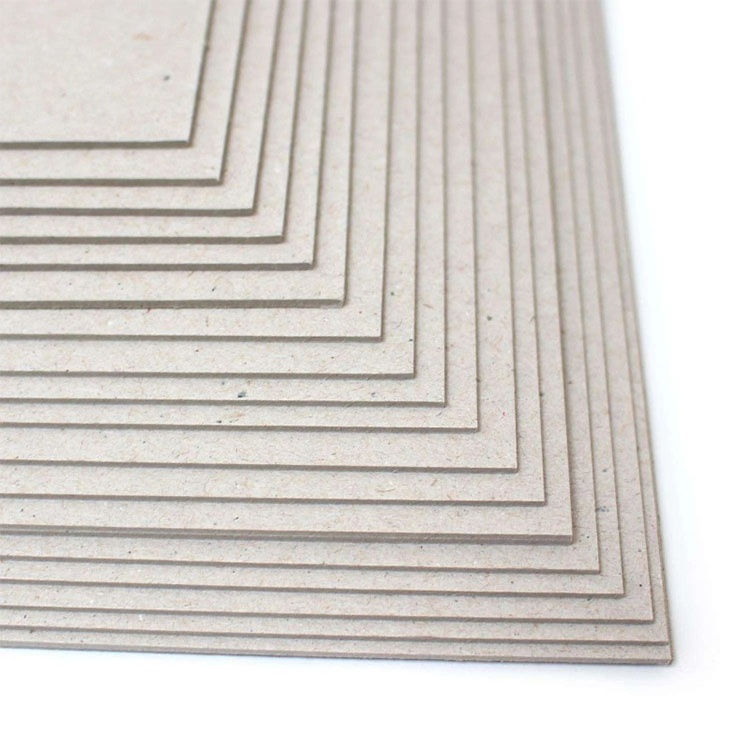
The GSM values below come from the Eska board technical specifications. They belong to that product grade; the prototype suggestions are my starting points for evaluation.
| Bare board caliper | Calculated packaging points | Eska board grammage | My prototype starting point |
|---|---|---|---|
| 1.20 mm | 47.2 pt | 755 GSM | Compact, lightly loaded formats |
| 1.50 mm | 59.1 pt | 945 GSM | Small accessories and gift packaging |
| 2.00 mm | 78.7 pt | 1,260 GSM | Medium presentation boxes with fitted inserts |
| 2.50 mm | 98.4 pt | 1,575 GSM | Larger panels or demanding product layouts |
| 3.00 mm | 118.1 pt | 1,890 GSM | Substantial presentation structures requiring validation |
These published values demonstrate a grade-specific relationship between caliper and grammage. Establish payload limits through testing of the complete package.
One packaging point equals 0.001 inch, or 0.0254 mm. Consequently, 2.00 mm equals approximately 78.7 pt, mientras que 80 pt equals 2.032 mm.
Commercial descriptions may round those numbers. Your purchase order should identify the controlling unit and tolerance.
My preference is millimetres as the controlling unit, with points shown as a reference when the buying team needs them.
A useful specification connects the material, inspection method, and finished box drawing. I would settle those three items before approving production.
“2 mm board” leaves its permitted variation unstated.
Eska publishes a ±3% pallet-average caliper tolerance for its board at thicknesses of 1.5 mm and above. For a nominal 2.00 mm grade, that calculates to a pallet-average range of 1.94–2.06 mm. The averaging basis matters: this figure does not establish an acceptance limit for every individual reading.
Ask the supplier to distinguish:
An average can conceal local variation. Both parties should know how that variation will be judged.
Specify ISO 534 for board thickness measurement and identify the conditioning procedure under ISO 187. Record the instrument, measurement atmosphere, and sample condition.
A caliper reading is only useful when the measurement procedure is reproducible.
El 2020 paperboard study by KTH and RISE researchers examined five folding boxboards at 20%, 50%, 70%, and 90% relative humidity, finding relationships between mechanical properties and moisture ratio; it used 23°C and 50% RH as the standard climate. Those findings concern folding boxboard, so the response of your selected rigid-box greyboard still requires its own verification.
My procurement takeaway is simple: agree on conditioning before comparing samples, then evaluate the finished pack under conditions relevant to its route and storage.
Here is an example for negotiation. The individual-reading limits are proposed purchasing requirements and require supplier agreement.
Core board: Approved mill and grade, 2.00 mm nominal bare-board caliper.
Caliper acceptance: Lot average 1.94–2.06 mm; individual readings 1.90–2.10 mm, subject to the agreed sampling plan.
Measurement: ISO 534; samples conditioned under ISO 187 at the agreed 23°C/50% RH atmosphere. Record actual conditions and instrument identification.
Construction: Identify base, lid, sleeve, and reinforcement board separately; record grain direction on the approved drawing.
Finished package: Dimensions, closure clearance, wrap, lining, adhesive system, and insert to match the approved drawing and production reference sample.
Changes: Obtain written approval before changing the board grade, nominal caliper, or layer construction.
Attach the sampling plan before production starts.
For a complex format, use rigid box structural design and engineering to resolve these relationships while the drawing can still be changed economically.
A thicker core changes geometry.
In a simple construction with fixed external dimensions, adding 0.5 mm to each of two opposing walls reduces the theoretical internal width by 1.0 mm, before accounting for wrapping and lining.
That can be enough to invalidate an insert drawing.
Para custom lift-off lid boxes, evaluate the relationship between the base’s finished outside dimensions and the lid’s finished inside dimensions.
Include wrap turn-ins, corner build-up, squareness, and the intended opening resistance.
I would ask the team to define an acceptable opening action using an approved sample. “A premium lift” is difficult to inspect consistently.
With paper drawer box packaging, check the complete sliding movement with the intended product loaded.
An empty drawer can feel acceptable while the loaded assembly binds or distorts. Assess the sleeve, tray, lining, and insert together, including any thickened seams along the travel.
Para rigid magnetic closure boxes, changes to board thickness can affect hinge geometry, flap alignment, and magnet positioning.
Approve the actual layer construction. Reusing the original drawing after increasing the board caliper creates an avoidable fit risk.
And record grain direction. Orientation belongs in the construction specification alongside thickness.
My buying rule is straightforward: every increase in caliper should answer a specific failure or performance requirement.
Does the lid bow? Does the base deflect under the product? Does an unsupported panel need reinforcement? Can a change to the insert or panel layout solve the problem?
Those questions make the material decision useful.
Consider an illustrative design using 0.25 m² of core board per box, with an assumed apparent density of 700 kg/m³.
Increasing the core from 2.0 mm to 2.5 mm adds:
0.25 m² × 0.0005 m × 700 kg/m³ = 0.0875 kg per box
That is 87.5 g per box, or 875 kg across 10,000 boxes.
Under those assumptions, raw core-board mass increases by 25%. Finished unit cost and freight charges need their own quotation; they will not necessarily rise by the same percentage.
For packaging supplied to the EU, Article 10 of Regulation (EU) 2025/40 sets a 1 January 2030 requirement to reduce packaging weight and volume to the minimum necessary for functionality, taking account of its shape and material.
I would retain the comparison samples and test results that explain the selected construction. That gives the team a defensible reason for using additional material.
Use packaging samples and prototyping to compare candidate calipers with the actual product, insert, wrap, and closure.
Agree on observable acceptance criteria: product fit, lid alignment, drawer movement, panel deformation, corner damage, and protection during the intended distribution cycle. Include the outer shipping package when evaluating transit performance.
A sample proves the configuration tested. Record it carefully enough to reproduce.
The best board thickness for rigid boxes is the thinnest specified core that meets the approved box’s stiffness, fit, appearance, and protection requirements, with 1.5–2.0 mm serving as a practical range to prototype for compact retail formats before considering thicker material for larger panels or heavier contents.
Board caliper converts to GSM only when the board’s apparent density is known, using GSM = thickness in millimetres × density in kilograms per cubic metre, so a 2.0 mm board at 700 kg/m³ calculates to 1,400 GSM while another grade can have a different grammage at the same thickness.
An 80 pt board is nominally 0.080 inches, or 2.032 mm, thick, while a 2.00 mm board is approximately 78.7 pt, so buyers should identify the controlling unit and permitted tolerance whenever a supplier treats these two commercial descriptions as interchangeable.
Greyboard thickness should be measured on conditioned, unwrapped board with a calibrated thickness instrument operating under the agreed paperboard test method, with readings taken across the agreed sheet and lot sample so that the report identifies the nominal caliper, observed variation, atmosphere, and acceptance basis.
Send XD Packaging your product dimensions, packed weight, preferred box style, insert requirements, order quantity, and shipping destination.
Request a rigid box thickness recommendation and ask for two candidate calipers, the proposed material grades and tolerances, and a prototype plan. Approve the finished fit and performance, then carry those requirements into the production order.